
Every culture on earth speaks a silent language made of shapes, colors, and images. A heart on a card, a dove on a wedding invitation, a red light at a crossing: these are all symbols, and humans have relied on them since long before written language existed.
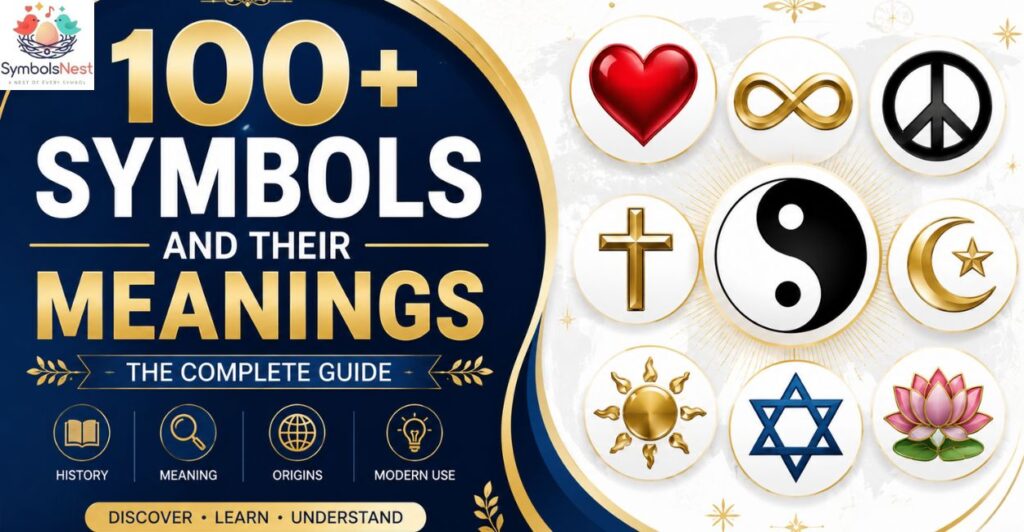
This guide brings together more than 100 common symbols and their meanings in one place. Whether you are curious about a spiritual symbol you saw in a temple, a shape you noticed in a logo, or an animal that keeps appearing in your dreams, you will find a clear, easy to read explanation below.
❤️ Red Heart Meaning: What Does the ❤️ Emoji Mean in Texts, Chat, Love & Social Media? (2026 Guide)
What Are Symbols?
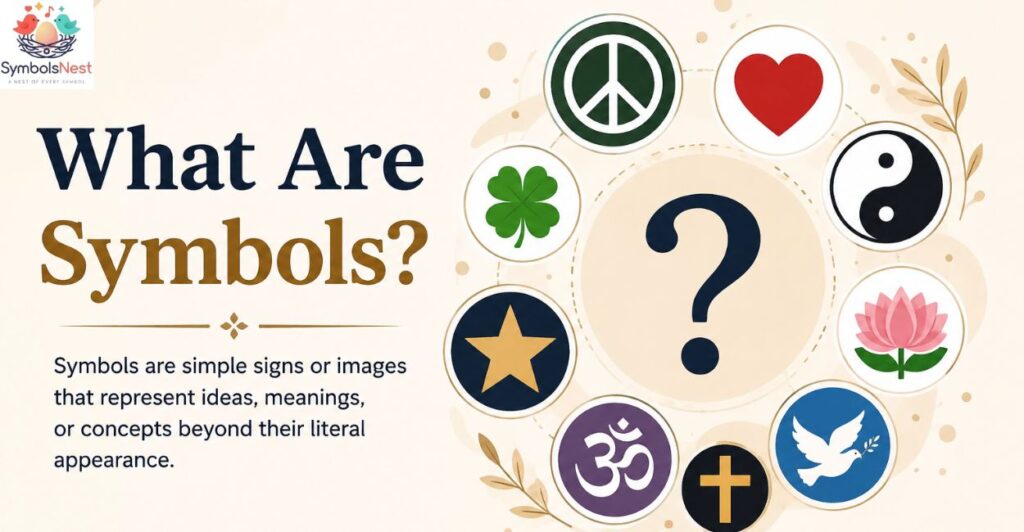
A symbol is an image, mark, sound, or object that stands for something beyond its literal appearance. A red rose is simply a flower, yet across most cultures it also represents romantic love.
A circle is only a shape, yet it commonly stands for unity, wholeness, and eternity because it has no beginning or end.
Symbols work because the human brain is wired to connect images with ideas, emotions, and memories.
Once enough people agree that a picture represents a concept, the symbol becomes part of a shared visual language.
This is why a stop sign is instantly understood in dozens of countries even though the words on it may differ.
Linguists and anthropologists often divide symbols into a few broad categories: natural symbols (like fire representing energy),
conventional symbols (like traffic signs, which are agreed upon by society), and universal symbols (like the sun, which tends to carry similar meaning in cultures that never had contact with each other).
Understanding these categories helps explain why some symbols, such as the heart or the circle, are recognized almost everywhere on the planet.
Symbols also differ from simple signs in an important way.
A sign, such as smoke indicating fire, has a direct and literal connection to what it represents.
A true symbol, on the other hand, is built on shared agreement rather than a direct physical link.
There is no natural reason a red octagon should mean stop, yet an entire society has agreed that it does, and that shared understanding is what gives the symbol its power.
Why Do Symbols Matter?
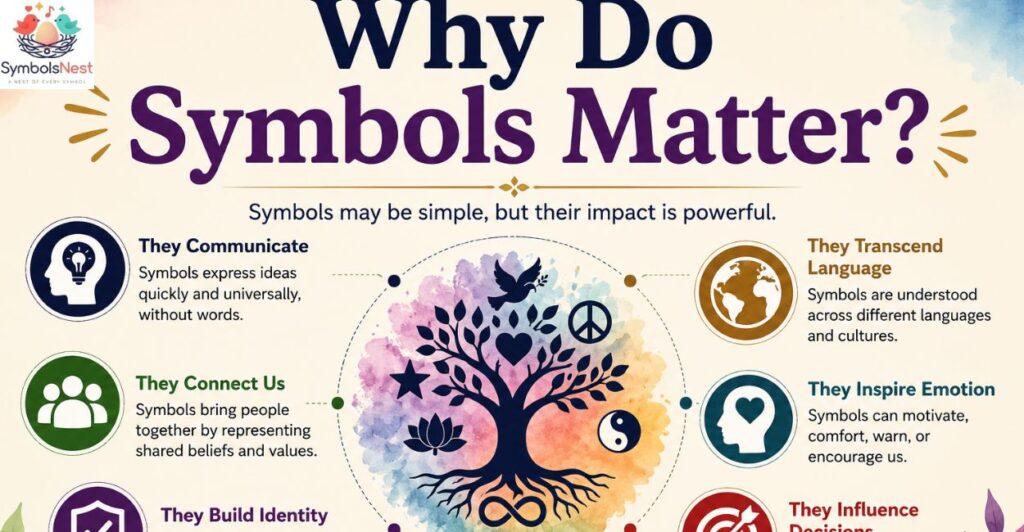
Symbols matter because they compress complicated ideas into a single, instantly recognizable image.
A wedding ring communicates commitment without a single spoken word.
A skull and crossbones warns of danger faster than a paragraph of text ever could. This efficiency is one reason symbols appear in religion, branding, medicine, mathematics, and everyday communication.
Symbols also carry emotional weight. A national flag can move an entire crowd to tears or cheers because it represents shared identity, history, and belonging.
Religious symbols such as the cross, the crescent moon, or the Star of David connect believers to centuries of tradition and faith in a single glance.
On a personal level, symbols help people process emotions and experiences that are hard to put into words.
This is part of why symbolic imagery shows up so often in art, tattoos, jewelry, and even dreams.
When someone chooses a butterfly tattoo after a difficult period in life, they are using an ancient symbol of transformation to represent their own personal growth.
Symbols also help societies pass knowledge down through generations without relying entirely on written text.
Long before most people could read, communities used carved and painted symbols to record important events, warnings, and beliefs.
This tradition still echoes today in everything from warning labels to religious iconography, proving that a well chosen symbol can outlast spoken language, changing borders, and even entire civilizations.
Types of Symbols
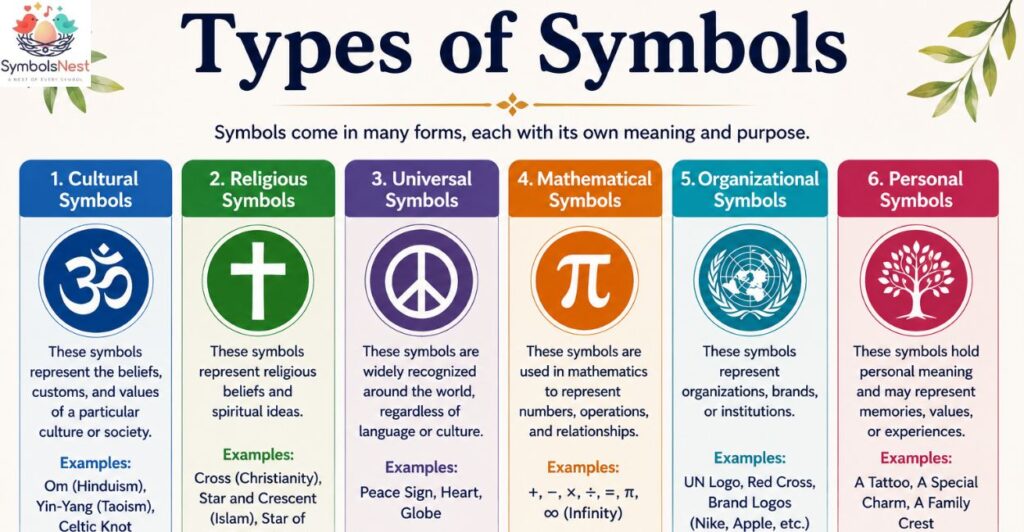
Symbols generally fall into several broad categories, and most of the 100+ symbols covered in this guide belong to one or more of these groups.
- Religious and spiritual symbols, such as the cross, the Om, and the Star of David
- Love and relationship symbols, such as hearts, rings, and doves
- Nature symbols, such as the sun, moon, water, and mountains
- Animal symbols, such as owls, wolves, and elephants
- Shape symbols, such as circles, triangles, and spirals
- Color symbols, which give meaning through hue rather than form
- Cultural and national symbols, such as flags and emblems
- Mathematical and punctuation symbols, which carry precise, agreed upon meanings
The sections below explore each of these categories in detail, offering short, clear explanations that are easy to scan and easy to remember.
Religious Symbols and Their Meanings
Religious symbols are among the oldest and most recognized images in human history. They condense entire belief systems into a single mark.
- The Cross represents Christianity, faith, sacrifice, and salvation through the crucifixion of Jesus Christ.
- The Crescent Moon and Star is closely associated with Islam and often represents faith, guidance, and divine light.
- The Star of David is a central symbol of Judaism, formed by two overlapping triangles that represent the connection between heaven and earth.
- Om (Aum) is a sacred sound and symbol in Hinduism, Buddhism, and Jainism, representing the vibration of the universe and spiritual awakening.
- The Dharma Wheel (Dharmachakra) symbolizes the Buddhist path to enlightenment and the cycle of rebirth.
- The Ankh is an ancient Egyptian symbol of life, often described as the key of eternal life.
- The Lotus Flower represents purity and spiritual awakening in Hinduism and Buddhism, since it rises clean from muddy water.
- The Trinity Knot (Triquetra) is linked to Celtic Christianity and represents the Father, Son, and Holy Spirit, though it also appears in earlier pagan traditions.
- The Yin Yang originates in Chinese Taoist philosophy and represents balance between opposing forces such as light and dark, or male and female energy.
- The Hamsa Hand is used across Middle Eastern and North African cultures as a symbol of protection against negative energy and the evil eye.
Religious symbols do more than decorate a building or a piece of jewelry. They act as a shorthand for entire theological systems, moral codes, and centuries of oral and written tradition.
A person who sees a cross on a hillside instantly understands they are near a Christian site, even without reading a single sign. In the same way, a crescent and star on a building signals a mosque, and a six pointed star signals a synagogue.
These visual cues allow strangers from completely different backgrounds to recognize a place of worship, a holiday, or a community within seconds, which is exactly why religious symbolism has remained so consistent across generations.
Love Symbols and Their Meanings
Love symbols express affection, commitment, and connection between people, and many of them have remained unchanged for centuries.
Heart Symbols: 150+ Heart Emoji Meanings, Colors, Text Symbols and Copy Paste Guide (2026)
- The Heart is the most universal symbol of love, affection, and emotional connection.
- The Wedding Ring symbolizes eternal commitment because a circle has no beginning or end.
- The Claddagh Ring is an Irish symbol showing hands holding a heart topped with a crown, representing love, loyalty, and friendship.
- The Dove represents peace, purity, and gentle, devoted love, and doves are often shown in pairs to symbolize lifelong partnership.
- The Rose, especially the red rose, is a classic symbol of romantic love and passion.
- Infinity Symbol represents love that has no end, often used in modern jewelry to signify a limitless bond.
- Cupid is drawn from Roman mythology and symbolizes romantic attraction and the spark of falling in love.
- Two Interlocking Rings represent unity and partnership, commonly seen in engagement and wedding imagery.
Love symbols tend to travel well between cultures because the emotion behind them is universal.
A traveler who does not speak a word of the local language will still understand a heart drawn on a napkin or a ring exchanged during a ceremony.
This is part of the reason love symbols dominate greeting cards, tattoos, and jewelry design worldwide. Many of these images, such as the heart or the ring, have been used for love and devotion for well over a thousand years, proving that some emotional shorthand simply never goes out of style.
Nature Symbols and Their Meanings
Nature has always offered humans a visual language for the forces that shape life on earth.
- The Sun symbolizes life, energy, power, and enlightenment in cultures around the world.
- The Moon represents intuition, femininity, cycles, and the passage of time.
- Water symbolizes purification, renewal, and the flow of emotion.
- Fire represents transformation, passion, and destruction that leads to rebirth.
- Mountains symbolize stability, strength, and spiritual ascent toward higher understanding.
- The Tree of Life represents growth, interconnectedness, and the link between the physical and spiritual worlds.
- Rainbows symbolize hope, diversity, and the bridge between different worlds or states of being.
- Rivers represent the continuous journey of life and the passage of time.
Nature symbols are considered some of the oldest in human history because they were the first things early humans observed and depended on for survival.
Long before organized religion or written language, communities were already tracking the sun for warmth, the moon for time, and rivers for travel and farming.
That deep, practical relationship with the natural world is exactly why these symbols carry such strong emotional weight even today, appearing in flags, logos, poetry, and personal artwork across every continent.
Animal Symbols and Their Meanings
Animals have carried symbolic meaning since prehistoric cave paintings, and each species tends to represent qualities humans admire or fear.
- The Owl symbolizes wisdom, intuition, and the ability to see what others cannot.
- The Wolf represents loyalty, family bonds, and untamed instinct.
- The Elephant symbolizes strength, memory, and wise leadership in many Asian and African traditions.
- The Butterfly represents transformation, rebirth, and personal growth.
- The Dove symbolizes peace and gentle guidance, and is often released at ceremonies to mark new beginnings.
- The Lion represents courage, authority, and royal power.
- The Snake symbolizes healing, transformation, and renewal because it sheds its skin.
- The Eagle represents freedom, vision, and connection to higher spiritual realms.
- The Turtle symbolizes patience, longevity, and steady progress.
- The Fox represents cleverness, adaptability, and quick thinking.
Animal symbolism often reflects the traits a culture admires or fears most in the natural world. Coastal cultures tend to elevate sea creatures such as whales and dolphins, while forest dwelling cultures often lean toward wolves, deer, and owls. This pattern shows that animal symbolism is rarely random.
It usually mirrors the landscape, the wildlife, and the survival challenges a community actually experienced, which is why the same animal can carry slightly different meanings depending on where the story originated.
Shape Symbols and Their Meanings
Simple geometric shapes are some of the most ancient symbols, appearing on pottery, cave walls, and sacred architecture long before written language.
- The Circle represents unity, wholeness, and eternity because it has no beginning or end.
- The Triangle symbolizes balance, strength, and the connection between mind, body, and spirit.
- The Square represents stability, order, and structure.
- The Spiral symbolizes growth, evolution, and the natural cycles of life.
- The Pentagon (five pointed star) represents protection and, in many traditions, the five elements of nature.
- The Hexagon symbolizes harmony and balance, often linked to efficiency in nature, as seen in honeycombs.
- The Star represents guidance, hope, and aspiration, historically used for navigation.
- The Diamond Shape symbolizes clarity, value, and perfection.
Geometric shapes are considered a kind of universal alphabet because they appear naturally in the world around us, from the circular shape of the sun and moon to the triangular shape of mountains.
Because these forms occur everywhere in nature, humans began attaching meaning to them long before complex symbols were invented, which explains why shape based symbolism still feels intuitive and easy to recognize today, regardless of language or location.
Color Symbolism and Meanings
Colors are among the most powerful symbols because they trigger emotional responses before a person even consciously registers what they are looking at.
| Color | Common Symbolic Meaning |
| Red | Passion, love, danger, energy |
| Blue | Calm, trust, wisdom, loyalty |
| Green | Growth, nature, prosperity, healing |
| Yellow | Happiness, optimism, warning |
| Purple | Royalty, spirituality, luxury |
| Black | Mystery, elegance, mourning, power |
| White | Purity, peace, new beginnings |
| Orange | Enthusiasm, creativity, warmth |
| Gold | Success, achievement, divine energy |
| Silver | Reflection, intuition, modernity |
Cultural context changes color symbolism significantly. White represents purity and weddings in many Western cultures, yet it symbolizes mourning and funerals in several East Asian traditions.
This is a helpful reminder that symbolic meaning is rarely fixed and often depends on the culture reading it.
Marketers and designers study color symbolism closely because the right color can shape how a brand feels within a fraction of a second.
A financial company might lean on blue to project trust and stability, while a fast food chain might choose red and yellow to trigger appetite and energy.
This same logic applies to personal choices too, from the color someone wears to an interview to the color chosen for a nursery, showing how deeply color symbolism has been absorbed into everyday decision making.
Spiritual Symbols Around the World
Beyond formal religion, many spiritual symbols are shared across belief systems and personal practice.
- The Third Eye represents inner wisdom, intuition, and heightened awareness beyond ordinary sight.
- The Mandala symbolizes the universe, wholeness, and the meditative journey toward inner peace.
- The Lotus appears again here as a spiritual symbol of enlightenment rising above difficulty.
- The Chakra Symbols represent the seven energy centers believed to govern physical and emotional wellbeing.
- Feathers symbolize spiritual connection, freedom, and messages from a higher power.
- The Evil Eye is used across Mediterranean and Middle Eastern cultures as protection against envy and negative intentions.
- The Tree of Life returns in a spiritual context as a symbol of the connection between all living things.
- Prayer Beads symbolize devotion, repetition, and the counting of sacred intentions.
Spiritual symbols tend to cross religious boundaries more easily than strictly religious ones.
The lotus flower, for example, appears in Hindu, Buddhist, and even some Egyptian traditions, while the third eye is referenced in Hindu philosophy, modern meditation practice, and popular wellness culture alike.
This overlap shows that spirituality often draws on a shared pool of imagery, even when the underlying belief systems developed independently of one another in different parts of the world.
Ancient Symbols and Their Meanings
Ancient civilizations left behind symbols that still influence modern design, jewelry, and storytelling.
- The Eye of Horus is an ancient Egyptian symbol of protection, health, and royal power.
- The Scarab Beetle represented rebirth and transformation in ancient Egypt.
- The Ouroboros, a snake eating its own tail, symbolizes the eternal cycle of life, death, and rebirth.
- The Celtic Knot represents the interconnected, never ending nature of life and spirit.
- The Fleur de Lis symbolizes royalty, purity, and light, closely tied to French monarchy and religious art.
- The Caduceus, a staff with two entwined snakes, is associated with commerce and, through common confusion, with medicine.
- The Ankh, mentioned earlier, remains one of the most recognized ancient symbols of eternal life.
- Runes, used by ancient Germanic peoples, were both an alphabet and a symbolic divination tool.
- The Labyrinth represents a spiritual journey toward self discovery, with a single winding path to the center.
- Spirals found in Newgrange and other Neolithic sites symbolize growth, the sun’s journey, and the cycle of seasons.
Archaeologists frequently rely on ancient symbols to reconstruct how early societies thought and communicated, long before a full written language existed. Carvings found on temple walls, tombs,
and pottery reveal that early humans were already assigning consistent meaning to specific shapes and images thousands of years ago.
Many of the ancient symbols listed above have survived because later civilizations adopted and reinterpreted them, carrying their core meaning forward even as the surrounding culture changed dramatically over time.
Math and Punctuation Symbols and Their Meanings
Not every symbol is ancient or spiritual. Mathematical and punctuation symbols have precise, agreed upon meanings that make communication and calculation possible.
- The greater than sign (>) shows that the value on the left is larger than the value on the right.
- The less than sign (<) shows that the value on the left is smaller than the value on the right.
- The equals sign (=) shows that two values or expressions are the same.
- The plus sign (+) represents addition or a positive value.
- The minus sign represents subtraction or a negative value.
- The percent sign (%) represents a portion out of one hundred.
- The asterisk (*) is commonly used for multiplication, footnotes, or emphasis.
- The ampersand (&) represents the word “and.”
- The intersection symbol (∩) and union symbol (∪) are used in set theory, where intersection shows shared elements and union shows all combined elements.
- The infinity symbol (∞) represents a quantity without any limit or end.
A quick way to remember greater than and less than is to picture the symbol as a mouth. The open side always faces the larger number, since the “mouth” wants to eat the bigger value.
National and Cultural Symbols
Countries and cultures use symbols to express shared identity, pride, and history.
- National Flags represent a country’s history, values, and sovereignty through chosen colors and imagery.
- The Bald Eagle symbolizes freedom and strength in American culture.
- The Maple Leaf represents Canadian identity and natural heritage.
- The Dragon symbolizes power, luck, and imperial authority in Chinese culture.
- The Cherry Blossom represents the fleeting beauty of life in Japanese culture.
- The Shamrock symbolizes Irish heritage and, historically, the Christian Holy Trinity.
- The Rising Sun represents renewal and national pride in several Asian cultures.
- National Emblems and Coats of Arms combine multiple symbols, such as animals, plants, and colors, to represent a nation’s complete identity.
National and cultural symbols serve a slightly different purpose than religious or personal symbols, since they are designed to unify large, diverse populations under a single shared identity.
A flag, an anthem, or a national animal gives citizens something to rally around during celebrations, sporting events, and even moments of crisis.
Because these symbols are often written into law and displayed in official settings, they tend to be among the most standardized and consistently recognized symbols within their country of origin.
Symbols of Protection and Good Luck
Across cultures, certain symbols are believed to guard against harm or invite good fortune.
- The Horseshoe is considered lucky when hung with the ends pointing upward, said to hold luck inside.
- The Four Leaf Clover represents rare good fortune because of its uncommon fourth leaf.
- The Evil Eye Amulet protects the wearer from envy and negative energy.
- The Hamsa Hand guards against misfortune and negative intentions.
- Garlic, in several European folk traditions, symbolizes protection against evil spirits.
- The Number Seven is widely considered lucky, tied to religious and natural patterns such as seven days in a week.
- Ladybugs are seen as a sign of good luck and protection in many cultures.
- Elephants with raised trunks are believed to bring luck, strength, and wisdom into a home.
Protective symbols exist in nearly every culture because the desire to feel safe from misfortune is a shared human experience.
Many of these symbols were originally created out of fear of illness, bad harvests, or unexplained tragedy, long before science could offer a rational explanation.
Over time, these protective images shifted from being purely functional charms into meaningful decorative pieces, though many people today still wear or display them for the same reassurance their ancestors sought centuries ago.
Symbols of Wisdom, Guidance, and Authority
Certain symbols are specifically tied to intelligence, direction, and power.
- The Owl, already mentioned above, remains the clearest universal symbol of wisdom.
- The North Star symbolizes guidance, direction, and a fixed point of reference during uncertain times.
- The Compass represents navigation, purpose, and finding one’s way through life.
- The Scepter symbolizes royal authority and the right to rule.
- The Crown represents leadership, sovereignty, and earned status.
- The Owl paired with the Book is a common academic symbol representing knowledge and lifelong learning.
Symbols of wisdom and authority often share a common thread: they represent something earned over time rather than granted instantly.
A crown must be inherited or won, a compass must be learned and trusted, and wisdom itself is generally viewed as something gathered through years of experience rather than a trait a person is simply born with.
This is likely why these particular symbols carry such weight in leadership, education, and storytelling across nearly every culture studied.
Symbols in Dreams and Their Hidden Meanings
Symbolism does not stop when people close their eyes. Dream interpretation relies heavily on recurring symbolic imagery.
- Water in dreams often represents emotion, and its clarity or turbulence tends to mirror the dreamer’s emotional state.
- Falling in dreams frequently symbolizes a loss of control or fear of failure.
- Flying in dreams can represent freedom, ambition, or a desire to rise above a current situation.
- Teeth falling out is a widely reported dream symbol linked to anxiety about appearance, aging, or loss of control.
- Being chased in dreams often symbolizes avoidance of a real life problem or emotion.
- Houses in dreams commonly represent the self, with different rooms symbolizing different aspects of the dreamer’s mind or memories.
Dream researchers generally agree that symbolic imagery in dreams is highly personal, even when certain images appear consistently across many different people.
A snake might represent fear for one person and transformation for another, depending on personal history and cultural background.
Because of this, most modern dream interpretation guides encourage readers to treat these symbols as a starting point for reflection rather than a fixed, one size fits all definition.
How Symbols Are Used in Everyday Life
Symbols are far more common in daily life than most people realize. Road signs use shapes and colors to communicate instantly, without relying on any single language.
Brand logos rely on simple, memorable symbols so customers recognize a company at a glance. Emojis have become a modern symbolic language, allowing people to express emotion and tone in text messages within a single character.
Medicine uses symbols such as the Rod of Asclepius to represent healing, while mathematics relies on symbols to communicate complex operations quickly and accurately. Even punctuation marks, such as a question mark or exclamation point, function as symbols that instantly signal tone and intent.
Religious and cultural symbols also appear constantly in daily settings, from jewelry and clothing to architecture and public monuments.
A single cross on a necklace, a crescent moon on a mosque, or a national flag outside a building can communicate identity and belief without a single spoken word.
Public safety also depends heavily on symbolic design. A red octagon means stop before a driver even reads the letters printed on it,
and a green circle means proceed at nearly every traffic light in the world. Airports, hospitals, and stadiums rely on internationally standardized symbols for restrooms, exits, and emergency equipment so that visitors from any country can navigate safely without needing to read local signage at all.
This shared visual system saves time, prevents confusion, and, in emergency situations, can genuinely save lives.
Symbols in Branding and Modern Design
Modern companies rely heavily on symbolism to build instant recognition without using a single word. A checkmark, an apple with a bite taken out, or a golden arch can communicate an entire brand identity in a fraction of a second, which is exactly why so much time and money goes into designing a simple, memorable logo.
- Checkmarks symbolize approval, correctness, and completion.
- Circular logos tend to symbolize unity, community, and inclusiveness, which is why so many social and nonprofit brands choose a circular mark.
- Arrows represent direction, progress, and forward movement, often used by logistics and technology companies.
- Shields symbolize protection, security, and trust, commonly used by insurance and cybersecurity brands.
- Leaves and green icons symbolize sustainability, freshness, and natural origin.
- Bold geometric shapes are often chosen by technology companies to symbolize precision, innovation, and modernity.
Beyond corporate logos, symbolism also shapes everyday digital communication.
App icons rely on quickly recognizable symbols, such as an envelope for mail or a magnifying glass for search, so users can navigate a device without reading a single label.
This same principle explains why emojis have grown into such a rich symbolic language of their own, allowing tone, emotion, and intent to travel across languages and cultures in a single small image.
Symbols and Meanings Across Different Cultures
The same symbol can carry very different, even opposite, meanings depending on where it is used. This comparison highlights a few examples where cultural context completely changes interpretation.
| Symbol | Meaning in One Culture | Meaning in Another Culture |
| White Color | Purity and weddings in Western cultures | Mourning and funerals in parts of East Asia |
| Owl | Wisdom in Western and Greek tradition | A bad omen in some Indigenous and African folklore |
| Number 4 | Neutral in most Western countries | Associated with bad luck in parts of East Asia due to its sound resembling the word for death |
| Elephant | Strength and luck in South Asian culture | Memory and gentle wisdom in Western storytelling |
| Red Color | Danger or warning in Western signage | Good luck and prosperity in Chinese culture |
This variation is a helpful reminder that symbolic meaning is shaped by history, language, and lived experience.
A symbol is rarely universal in every single detail, even when its core emotional impact feels similar across different parts of the world.
How to Interpret the Meaning of a Symbol
Understanding what a symbol means usually starts with identifying it correctly. The fastest modern method is a visual search tool.
Google Lens allows anyone to take a photo of a symbol and instantly pull up matching images along with background information and history.
On an iPhone, Apple’s Visual Look Up feature works similarly, letting a person tap the information icon on a photo to identify the object or symbol shown.
Once a symbol is identified, interpretation depends on context. The same shape or image can carry different meanings depending on the culture, time period, and setting in which it appears.
A useful approach is to look at three layers of meaning: the literal appearance of the symbol, its historical or cultural origin, and the emotional or personal meaning it might hold for the individual viewing it.
Cross referencing a symbol across multiple reliable sources, such as museum archives, academic writing, and cultural encyclopedias,
helps avoid misinterpretation, since many symbols have been reused or reshaped by different groups over centuries.
It also helps to consider who originally created the symbol and who is using it today, since the two are not always the same.
Some symbols have been reclaimed, others have been misused outside their original context, and a few have simply drifted in meaning as they moved between generations.
Approaching an unfamiliar symbol with curiosity rather than assumption is generally the safest and most respectful way to learn its true significance.
Quick Reference Table of Popular Symbols
| Symbol | Primary Meaning |
| Heart | Love, affection, emotional connection |
| Peace Sign | Nonviolence, harmony, unity |
| Yin Yang | Balance between opposing forces |
| Cross | Faith, sacrifice, salvation |
| Om | Universal vibration, spiritual awakening |
| Ankh | Eternal life |
| Owl | Wisdom, intuition |
| Dove | Peace, purity, devotion |
| Infinity Symbol | Endlessness, limitless love |
| Lotus | Purity, spiritual growth |
| Star of David | Divine connection, Jewish identity |
| Tree of Life | Growth, interconnectedness |
| Evil Eye | Protection from envy |
| Four Leaf Clover | Rare good luck |
| North Star | Guidance, direction |
| Crown | Authority, leadership |
| Butterfly | Transformation, rebirth |
| Rainbow | Hope, diversity |
| Spiral | Growth, evolution |
| Hamsa Hand | Protection, blessing |
Frequently Asked Questions
How can I find out what a symbol means?
Take a photo of the symbol using Google Lens or Apple Visual Look Up to identify it, then research its cultural or historical origin for full context.
What are some symbols and their meanings?
Common examples include the heart for love, the dove for peace, the owl for wisdom, and the cross for faith, each carrying centuries of shared cultural meaning.
What does the greater than symbol (>) mean?
It shows that the value on the left side is larger than the value on the right side in a mathematical comparison.
What does the less than symbol (<) mean?
It shows that the value on the left side is smaller than the value on the right side in a mathematical comparison.
What animal represents wisdom and guidance?
The owl is the animal most widely recognized as a symbol of wisdom, insight, and guidance across many cultures.
What symbolizes new beginnings and growth?
The lotus flower, the spiral, and the sunrise are all common symbols of new beginnings, renewal, and personal growth.
What is a symbol of authority?
The crown and the scepter are classic symbols of authority, representing leadership and the right to rule.
Common Mistakes People Make When Interpreting Symbols
Even experienced researchers occasionally misread a symbol, usually because of a few common mistakes that are easy to avoid once you know what to look for.
- Assuming one meaning fits every culture. A symbol that means good luck in one country can mean something completely different, or even negative, in another.
- Ignoring the historical time period. Many symbols have shifted meaning significantly over hundreds or thousands of years, so a modern interpretation may not match the original one.
- Relying on a single source. A single website or social media post can spread an inaccurate or oversimplified meaning quickly, so checking multiple credible sources is always worthwhile.
- Confusing similar looking symbols. Small differences in shape, color, or orientation can completely change a symbol’s meaning, such as a horseshoe pointing up versus pointing down.
- Overlooking personal or religious sensitivity. Some symbols carry deep spiritual weight for certain communities, so context and respect matter just as much as accuracy.
Taking a little extra time to research a symbol properly, rather than accepting the first explanation found online, leads to a far more accurate and meaningful understanding of what it truly represents.
Final Thoughts
Symbols connect people across time, language, and culture in a way that few other tools can. From the ancient Egyptian Ankh to the modern infinity sign on a piece of jewelry, each image carries layers of history, belief, and emotion. Learning what common symbols mean is not just an interesting exercise; it deepens the way people understand art, religion, relationships, and even their own dreams.
Whether the goal is identifying a mysterious symbol spotted on a trip, choosing a meaningful tattoo, or simply satisfying curiosity, this guide offers a solid starting point. Explore the linked cluster articles on heart symbols, religious symbols, nature symbols, shape symbols, and love symbols for a deeper dive into each category.

hi iam Emma SymbolsNest.com is a simple website where you can find thousands of symbols and special characters. It helps you copy and paste Unicode symbols for social media, messages, documents, and creative projects.
